
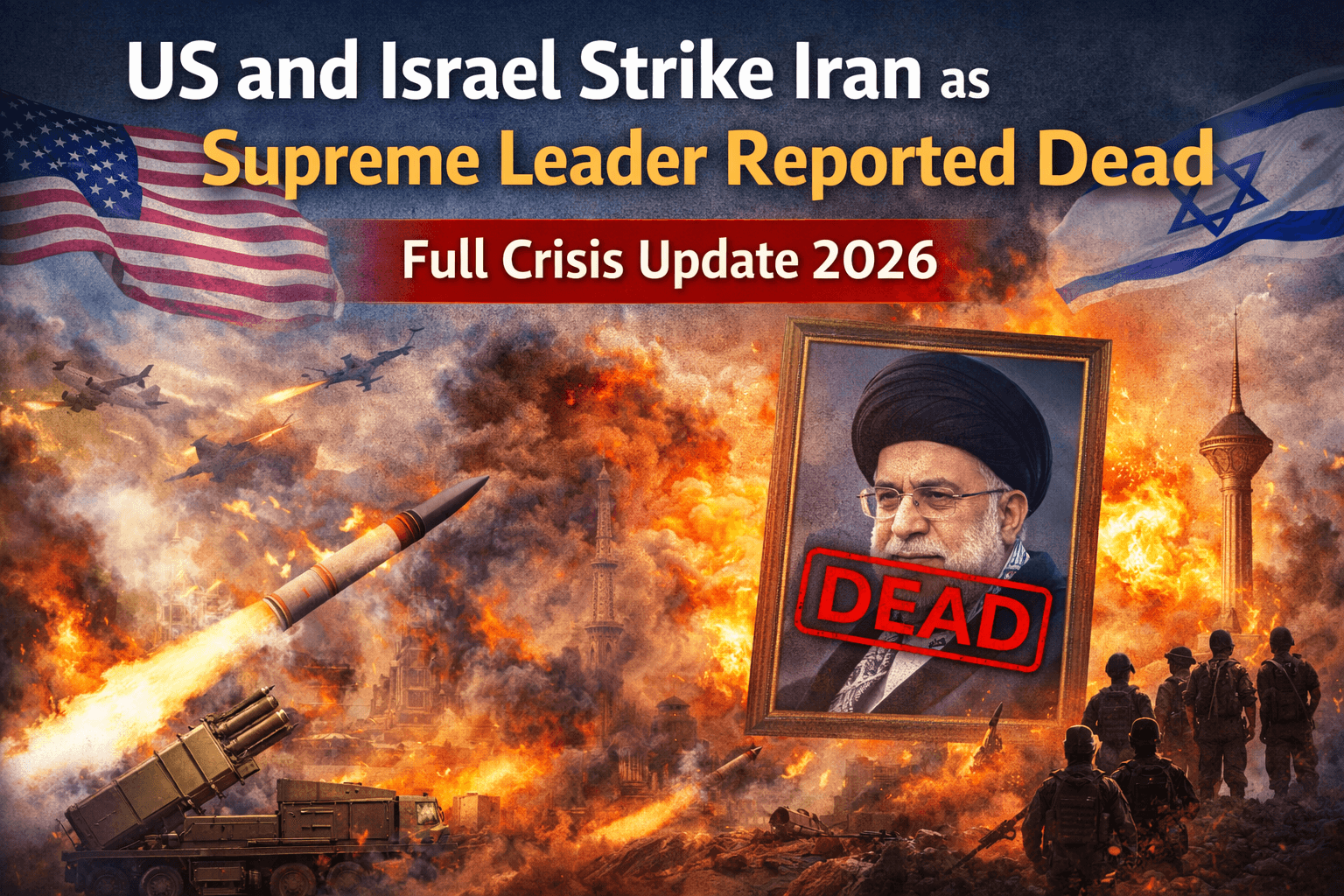
Tensions in the Middle East sharply increased after United States President Donald Trump announced that Iran’s Supreme Leader Ayatollah Ali Khamenei had been killed during joint military strikes carried out by the United States and Israel. Iranian state media later reported that Khamenei had died in the attacks.
The situation has led to major military exchanges, political reactions, and growing global concern about further escalation in the region.
What Happened
According to statements from Washington, the United States launched large scale military operations targeting key sites inside Iran. Israeli forces also carried out strikes aimed at military and political leadership figures.
US officials said the operation focused on Iran’s ballistic missile systems and nuclear related facilities. Israeli officials stated that the goal was to weaken what they described as security threats against Israel and its allies.
President Trump urged the Iranian public to seek political change after the strikes, saying the moment could bring a new chapter for the country.
Casualties and Damage
The Iranian Red Crescent reported that more than 200 people were killed and hundreds more injured following the attacks. Iranian authorities described the deaths as acts of aggression and declared a national mourning period.
Iranian President Masoud Pezeshkian called Khamenei’s death a martyrdom and promised a response. State media announced 40 days of mourning across the country.
Several other senior Iranian officials were also reported killed, including military and security leaders.
Iran Responds
In response, Iran launched missiles toward Israel and targeted US military bases in several countries across the region. These included bases in
• United Arab Emirates
• Qatar
• Kuwait
• Bahrain
• Jordan
US Central Command said there were no confirmed American casualties. Some regional governments reported intercepting missiles and drones before impact.
Airspace across parts of the Middle East was temporarily closed, causing flight disruptions and travel delays.
Weapons Used in the Operation
US officials stated that the military operation included the use of precision missiles launched from naval ships and fighter aircraft. For the first time, one way attack drones were also reportedly used in the conflict.
Military analysts say oil markets may react strongly, with possible increases in global fuel prices depending on how the situation develops.
Political and International Reaction
At the United Nations, representatives from both sides exchanged strong statements. Iran’s ambassador described the strikes as violations of international law, while US officials defended the action as necessary for national and regional security.
In the United States, law enforcement agencies increased security at sensitive locations as a precaution against possible retaliation.
Public reactions were mixed. Demonstrations were reported in cities including New York City and Los Angeles, where members of the Iranian diaspora expressed different views on the developments.
What Happens Next
Under Iran’s constitution, the Assembly of Experts is responsible for selecting a new Supreme Leader. Until then, temporary leadership arrangements may be put in place.
Foreign policy experts say the coming days will be critical. While some leaders have called for regime change, others warn that sudden political shifts in a country of over 90 million people could lead to instability.
Iran’s foreign minister signaled that Tehran may be open to discussions if military actions stop, suggesting there could still be space for diplomacy.
Global Impact
The conflict has already affected global markets and regional stability. Oil prices are expected to rise if tensions continue. Airlines are adjusting routes, and governments worldwide are monitoring the situation closely.
The Middle East remains on high alert as leaders assess the consequences of one of the most serious escalations in recent years.
More updates are expected as official statements and verified reports continue to emerge.
please increase the lenghts also add faqs
Middle East Crisis 2026
US and Israel Launch Major Strikes on Iran as Regional Tensions Rise
Tensions in the Middle East have sharply increased following large scale military strikes carried out by the United States and Israel inside Iran. The situation escalated after US President Donald Trump announced that Iran’s Supreme Leader Ayatollah Ali Khamenei had been killed in the operation. Iranian state media later confirmed his death, marking one of the most dramatic developments in the region in decades.
The strikes and the aftermath have triggered military responses, political reactions, and growing international concern about the risk of a wider conflict.
Background of the Conflict
Relations between the United States and Iran have been tense for many years, mainly due to disagreements over Iran’s nuclear program, regional influence, and military activities. Israel has also repeatedly expressed concern over Iran’s missile capabilities and its support for armed groups in the region.
In recent months, diplomatic talks reportedly failed to produce an agreement. According to US officials, the breakdown in negotiations played a role in the decision to move forward with military action.
The operation, described by American officials as a targeted mission against military infrastructure, quickly expanded into a major regional event.
Details of the Military Operation
US and Israeli forces reportedly targeted:
• Ballistic missile facilities
• Air defense systems
• Military command centers
• Strategic security compounds
US officials said the objective was to weaken Iran’s military capabilities and reduce what they described as long term security threats.
Reports indicate that precision guided missiles were launched from naval ships and fighter aircraft. One way attack drones were also used during the operation. Military sources stated that hundreds of targets were struck within a short time frame.
President Trump described the operation as successful and said it inflicted significant damage on Iranian military infrastructure.
Casualties and Human Impact
The Iranian Red Crescent reported that more than 200 people were killed and approximately 700 were injured in the attacks. Iranian officials declared a period of national mourning and described the deaths as acts of aggression.
Iranian President Masoud Pezeshkian publicly honored Khamenei and pledged that the country would respond. Government buildings lowered flags to half staff, and state media broadcast mourning messages nationwide.
In addition to Khamenei, several senior military officials were reported killed, including high ranking members of the Islamic Revolutionary Guard Corps.
Iran’s Response
Iran responded by launching missiles and drones toward Israel and US military facilities across the region. Strikes were reported near bases located in:
• United Arab Emirates
• Qatar
• Kuwait
• Bahrain
• Jordan
US Central Command stated that there were no confirmed American casualties. Some countries in the Gulf region reported intercepting incoming missiles and drones before they reached their targets.
The situation remains fluid, with military forces on high alert across the Middle East.
Global Reaction
The international community reacted quickly. At the United Nations, diplomats from multiple countries called for restraint and dialogue. Iran’s ambassador criticized the strikes as violations of international law, while US representatives defended them as actions taken in self defense.
Several countries temporarily closed their airspace, leading to major flight disruptions. Airlines diverted routes, and thousands of travelers faced delays.
Oil markets reacted immediately. Analysts warned that crude oil prices could rise significantly if the conflict continues. Higher oil prices may result in increased fuel costs worldwide.
In cities such as New York City and Los Angeles, demonstrations were held by different groups expressing both support and opposition to the military action.
Political Uncertainty Inside Iran
Under Iran’s constitution, the Assembly of Experts is responsible for appointing a new Supreme Leader. Until a successor is chosen, temporary leadership arrangements may be implemented.
Experts believe the transition period could be sensitive. Iran is a country of more than 90 million people with diverse ethnic, political, and social groups. Sudden changes at the top level of leadership may create uncertainty in both domestic and foreign policy.
At the same time, Iran’s foreign minister signaled that the country may be open to diplomatic discussions if military operations stop, suggesting that a path toward de escalation could still exist.
Security Concerns in the United States
US law enforcement agencies increased security measures around military facilities, government buildings, and religious institutions as a precaution. Officials said they are monitoring potential threats and coordinating with intelligence agencies.
Despite rising tensions, authorities reported no confirmed attacks on US soil.
Economic and Regional Impact
The Middle East plays a critical role in global energy supply. Any prolonged instability could affect oil production and shipping routes. Financial markets are closely watching the situation.
If the conflict expands, global trade, fuel prices, and airline operations may continue to experience disruption.
Governments worldwide have urged calm and encouraged diplomatic efforts to prevent further escalation.
Frequently Asked Questions
1. Why did the United States and Israel launch strikes on Iran
US officials stated that the strikes were aimed at weakening Iran’s missile systems and nuclear related facilities. Israel said it acted to remove what it viewed as a direct security threat.
2. Has Iran officially confirmed the death of Ayatollah Ali Khamenei
Iranian state media reported that Khamenei was killed in the strikes. Government officials declared a national mourning period following the announcement.
3. How did Iran respond to the attacks
Iran launched missiles and drones toward Israeli territory and US military bases in several Middle Eastern countries. Some attacks were intercepted before impact.
4. Are there American casualties
US Central Command reported no confirmed American casualties following the retaliatory strikes.
5. What could happen next in Iran
According to Iran’s constitution, the Assembly of Experts will choose a new Supreme Leader. Political analysts say the leadership transition could influence both domestic stability and foreign relations.
6. How could this affect global oil prices
Military conflict in the Middle East often impacts oil markets. Analysts suggest prices may increase if tensions continue, potentially leading to higher fuel costs worldwide.
7. Is there still a chance for diplomacy
Iranian officials have indicated they may be open to discussions if military action stops. International leaders are calling for dialogue to prevent further escalation.
Conclusion
The situation between the United States, Israel, and Iran represents one of the most serious geopolitical developments of 2026. While military operations have caused significant changes on the ground, diplomatic efforts may still shape the outcome.
The coming days will be critical in determining whether tensions decrease through negotiation or increase further. Governments, markets, and citizens around the world continue to watch closely as events unfold.